For several years, there had been expectations that Saudi Arabia would establish a dedicated regulator for its insurance sector, reflecting growing recognition that insurance and reinsurance are essential to a modern, diversified economy.
That expectation was closely tied to the country’s broader economic transformation under Vision 2030, the strategy unveiled in April 2016 to reduce dependence on oil and build a globally connected economy. As the reform programme gathered pace, the insurance sector increasingly emerged as a cornerstone of national economic resilience, safeguarding investments and supporting long-term sustainable growth.”
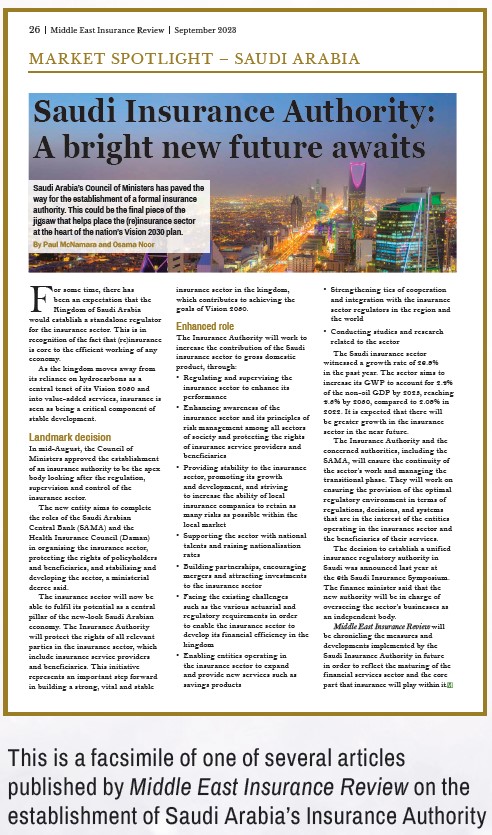
Against this backdrop, the long-anticipated establishment of Saudi Arabia’s Insurance Authority (IA) became a reality in August 2023, when the Council of Ministers approved the creation of the Kingdom’s independent insurance regulator. Middle East Insurance Review was among the first industry publications to report the landmark decision, recognising it as a significant milestone in the evolution of Saudi Arabia’s insurance sector. Shortly afterwards, the Official Gazette published the “Regulation of the Insurance Authority” on 25 August 2023, setting out the Authority’s legal framework. The regulation came into force 90 days later, laying the foundation for the Insurance Authority’s operations and ushering in a new era of unified insurance regulation in the Kingdom.
The Insurance Authority was created to oversee the regulation, supervision and development of the insurance sector, consolidating responsibilities previously shared by the Saudi Central Bank (SAMA) and the Council of Health Insurance (CHI).
In March 2024, the Insurance Authority assumed responsibility for supervising health insurance from the Council of Health Insurance, giving it oversight of all insurance activities under a single regulator.
 Reforms
Since its inception, the Authority has implemented a series of reforms to modernise the Kingdom’s insurance sector. It aims to strengthen governance, protect the rights of policyholders and beneficiaries, and support the development of a stable and competitive insurance market.
The comprehensive mandate of the Authority includes: expanding the sector’s contributions to the economy by elevating regulatory oversight, promoting risk management, ensuring market stability and encouraging innovation. Its functions also include supporting local talent, attracting investment, facilitating mergers, strengthening insurers’ risk retention capabilities, enabling the creation of new products such as savings solutions, fostering international regulatory cooperation, and conducting research to support evidence-based policymaking.
The reforms were launched against the backdrop of Saudi Arabia’s rapidly growing insurance market, with the sector recording growth of 26.9% in 2022 to chalk up premium income of SAR53.36bn ($14.2bn at the 2022 average exchange rate). 2022 was the year preceding the establishment of the Insurance Authority.
 Repositioning for bigger role
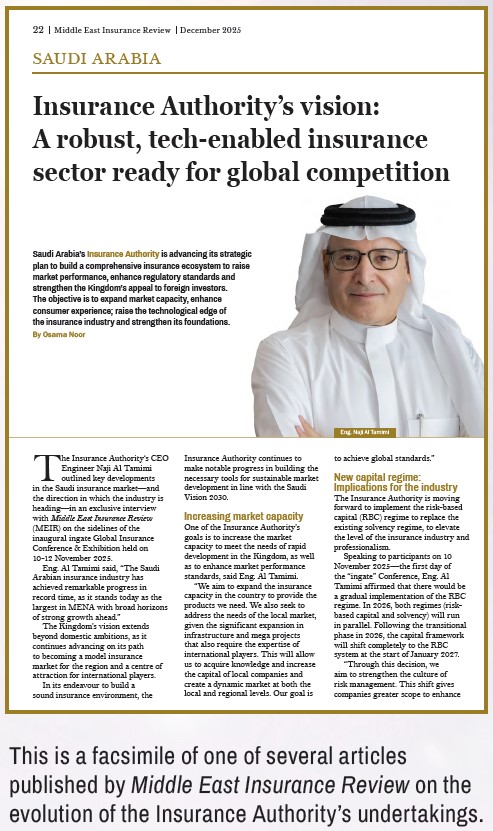
By the end of 2025, the Insurance Authority had shifted its focus from establishing a unified regulatory framework to positioning Saudi Arabia as a leading global insurance market. In an exclusive interview with Middle East Insurance Review late last year, the Insurance Authority‘s CEO, Engineer Naji Al Tamimi, said Saudi Arabia had become the largest insurance market in the Middle East and North Africa and remained on track for further growth. He said that the Kingdom’s ambitions extend beyond meeting domestic demand, with the IA seeking to position Saudi Arabia as a regional insurance hub and an attractive destination for international insurers and investors in line with Vision 2030.
The efforts of the Insurance Authority culminated in January 2026 with the adoption of the National Insurance Sector Strategy which positions insurance as a core economic pillar under Vision 2030. Overseen by the Insurance Authority, the strategy aims to double the market’s contribution to GDP to 3.6% and expand its overall size to SAR140bn ($37.3bn) by 2030.
A key element of the Authority’s strategy is expanding market capacity while raising regulatory and professional standards. Eng. Al Tamimi said the regulator was working to strengthen local insurance capabilities to support the Kingdom’s rapidly expanding infrastructure and pipeline of mega-projects, while welcoming international expertise to deepen market knowledge and capital.
RBC
He also outlined plans to implement a risk-based capital (RBC) regime, which will run alongside the existing solvency framework in 2026 before becoming the sole capital standard in January 2027. According to Eng. Al Tamimi, the reform will strengthen risk management, improve underwriting discipline, encourage innovation, attract investment and reduce the industry’s reliance on reinsurance.
“We aim to expand the insurance capacity in the country to provide the products we need. We also seek to address the needs of the local market, given the significant expansion in infrastructure and mega-projects that also require the expertise of international players. This will allow us to acquire knowledge, increase the capital of local companies and create a dynamic market at both the local and regional levels.”
New legislation and technology
Alongside capital reforms, the Insurance Authority has also been laying the legislative foundations for a more mature insurance market. Eng. Al Tamimi said a new insurance law would establish a modern governance framework for insurers, intermediaries and policyholders, with supporting regulations to follow.
Technology is another cornerstone of the Authority’s long-term strategy. At the end of 2025, the IA launched its RegTech Hub, a platform designed to collect and analyse industry-wide data, giving supervisors real-time insights into underwriting, claims, pricing and operating performance. Combined with artificial intelligence, the platform is expected to strengthen regulatory oversight, identify emerging market risks and enhance consumer protection.
On the cusp of transformation
Saudi Arabia’s insurance market stands at a transformative inflection point. From consolidating supervision under a single regulator to driving digital transformation, the Insurance Authority has laid a robust foundation for a modern, world-class market. As Saudi Arabia advances toward its 2030 targets, backed by a risk-based capital framework and the ambitious National Insurance Sector Strategy, the Kingdom is no longer just expanding its domestic market; it is rapidly establishing itself as a dominant regional insurance hub and a vital pillar of national economic resilience. M